
Travel writing based on first-hand experience
Is Shibuya Sky Worth It? Let’s Be Honest…
Every Tokyo itinerary, every travel blog, every friend who’s been to Japan seems to whisper the same thing: “You have to go to Shibuya Sky.” But is it really worth carving out time (and yen) for yet another observation deck? After all, Tokyo has no shortage of tall buildings with sweeping views. Why this one?
In short? If you’re wondering whether Shibuya Sky deserves a spot on your Tokyo must-do list — the answer is almost certainly yes. But before you book those tickets, let’s dive into what makes it so special — and why, for many travelers, it ends up being the highlight of the entire trip.
Planning the rest of your Tokyo adventure?
Build the rest of your trip with our complete Tokyo travel guide, or squeeze the city’s biggest sights into our one-day Tokyo itinerary. For more skyline views after Shibuya Sky, compare the best rooftop bars in Tokyo, then escape the capital with one of the best day trips from Tokyo.
Table of Content
The Way Up – Anticipation in the Shibuya Sky Elevator
October, late afternoon. Shibuya is buzzing, neon signs flickering like impatient fireflies, and yet here I am — queuing for a lift that promises to shoot us straight into the clouds. I heard the hype: “best view in Tokyo,” “must-see observation deck,” what I hadn’t expected was that the journey itself — from mall floor to sky platform — would feel like stepping into another world.
Launch Sequence – Boarding the Sky Elevator
Your ascent into the heavens begins, unexpectedly, on the 14th floor. That’s the “mission control” level — ticket counters, security checks, and the place where your Tokyo skyline adventure truly kicks off. Skip the endless maze of shops below and head straight here by elevator.
I pre-ordered our ticket through Klook, and thank goodness I did. All it took was a quick QR scan and I was cleared for takeoff. The bonus? Free cancellation if the weather turns on you — which, considering how fickle Tokyo skies can be, is a lifesaver. Even during our so-called “off-season” visit, same-day tickets had vanished before noon. Lesson learned: if the forecast promises clear skies, book early. Time slots disappear faster than you can say “panoramic selfie.”

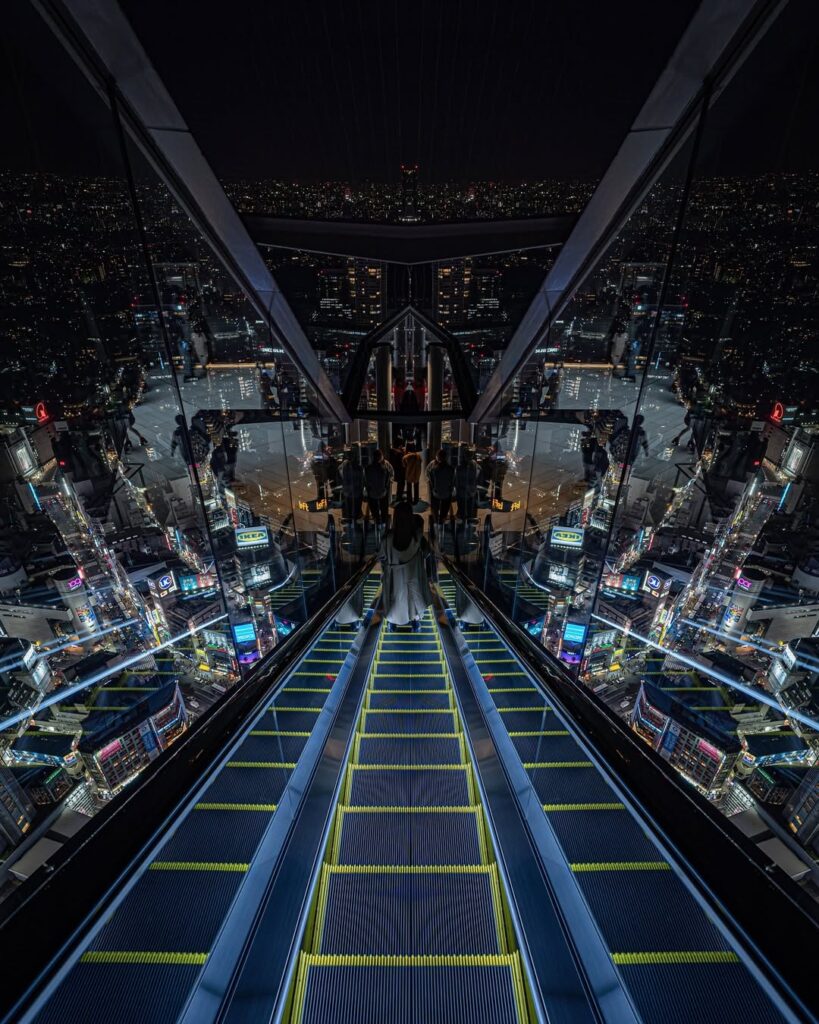
And then, the elevator. Oh, the elevator. It’s not transport — it’s theatre. In just seconds you rocket from the 14th to the 45th floor, lights pulsing, ambient sounds swelling, like you’re aboard a starship breaking orbit. And then: ping. Doors open. A few steps later, you’re out in the open, 229 metres above the ground, face-to-face with the Tokyo sky.
Before you get too giddy, though, there’s one last ritual: lock up everything that could fly away. Bags go into free lockers, hats and headphones included. Selfie sticks are a hard no (potential projectiles, apparently). Cameras and binoculars are fine, provided they’re attached to you. And with that — it’s time to ascend the final escalator to the Sky Deck itself.
The moment you step onto the platform, the noise drops away. Not because Shibuya’s gone quiet — it hasn’t — but because from up here, the city seems too small to make a sound. It’s as if you’re gazing down at a living, breathing diorama. The cars crawl, the trains glide, the neon pulses. You don’t just see Tokyo. You feel it. Like you’re floating above its heartbeat.
Skyline in All Directions – A 360° “Wow”
Do a slow spin on the Sky Deck and you’ll quickly notice there’s no such thing as a “bad angle” here. Every direction tells a different story. To the east, a patchwork of rooftops unfurls endlessly, sliced by glittering ribbons of road. Beyond, Tokyo Bay shimmers — cranes, ferries, and docklands frozen in miniature below you. It’s like looking out of a plane window, except the ground isn’t moving.
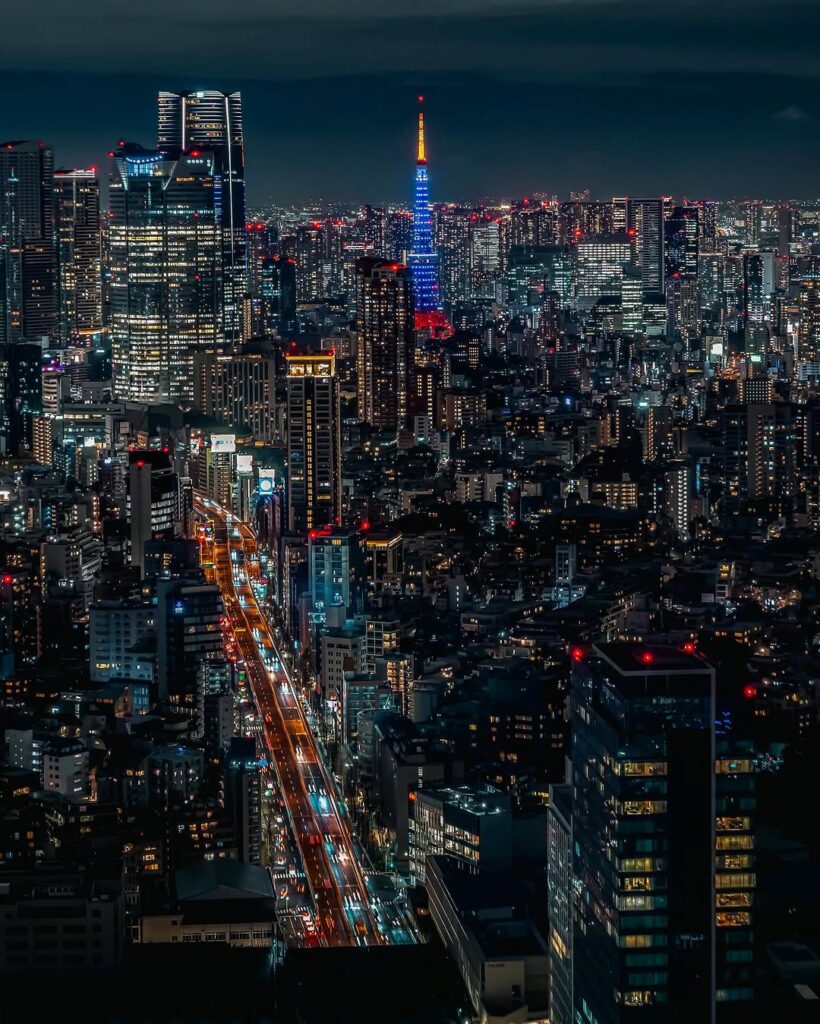
Turn north and the cityscape rearranges into neat rows of skyscrapers around Ikebukuro and the distant Ueno district. Pivot south and there’s Roppongi, with the Tokyo Tower peeking over the horizon — daintier than you’d expect, like an elegant red needle stitching sky and skyline together.
But it’s the west that delivers the real gut punch. On a clear day — and Tokyo blesses you with those more often than you think- Mount Fuji materialises on the horizon. Snow-capped and serene, it looks less like a mountain and more like a painting. Distant yet deeply present. That first glimpse alone makes Shibuya Sky worth every yen.
Ants Below – The Hypnotic Ballet of Shibuya Crossing

Most people’s eyes shoot straight toward the horizon up here — and fair enough. But do yourself a favor and look down. Directly beneath your feet, Shibuya Crossing is performing its world-famous dance. From 229 meters up, it’s mesmerizingly surreal: tiny figures mass at the corners, the lights flip, and suddenly the intersection blooms into organized chaos. Streams of people surge in every direction, perfectly timed and yet wildly unpredictable.
Every one of them has a destination — a meeting, a job, a rendezvous — but from this height, they look like ants, each following a pattern you can’t quite decode. It’s the strangest, most beautiful paradox: total detail and total detachment. You can see the buses looping around corners, a cyclist weaving through the crowd, a single impatient taxi stuck at red. Tokyo reveals itself here not as a city but as a living organism — and you, for once, are simply the observer.
Before the end of April, if luck’s on your side, grab a seat on one of the platform’s sofas. From there, you can just sit, breathe, and let the city’s pulse wash over you. (Pro tip: from late April through December, those seats become VIP territory for ticket-holders to THE ROOF SHIBUYA SKY.)
It’s a strange, beautiful headspace. Part meditation, part cinema, part lucid dream. The city roars below — and yet, somehow, you’re untouchable. Maybe that’s the real magic of Shibuya Sky: the view isn’t just about scale. It’s about perspective. From up here, everything makes a little more sense. And maybe, just maybe, everything feels a little less heavy.
City Meets Sky – When Weather Plays Its Part
One reason Shibuya Sky feels so different from other observation decks? There’s no glass dome or steel canopy separating you from the elements. Above you is nothing but sky. Below you, the largest city on Earth. That openness changes everything. The wind tangles your hair, the sunlight splashes across glass facades, and suddenly you’re not just a spectator — you’re part of the scene.
And here’s a tip: come more than once if you can. The view isn’t static — it’s a living thing. Morning brings a cool, analytical Tokyo, sharp-edged and efficient. Midday is loud and luminous, the city at full volume. And by late afternoon, golden light softens the skyline, stretching shadows and turning chaos into choreography.
When clouds roll through, the whole panorama transforms. Shadows chase sunlight across rooftops, shafts of brightness dart down side streets, and you realize just how small even a metropolis like Tokyo is compared to nature’s canvas. That dance of weather and architecture? Pure poetry — and you’re standing right in the middle of it.
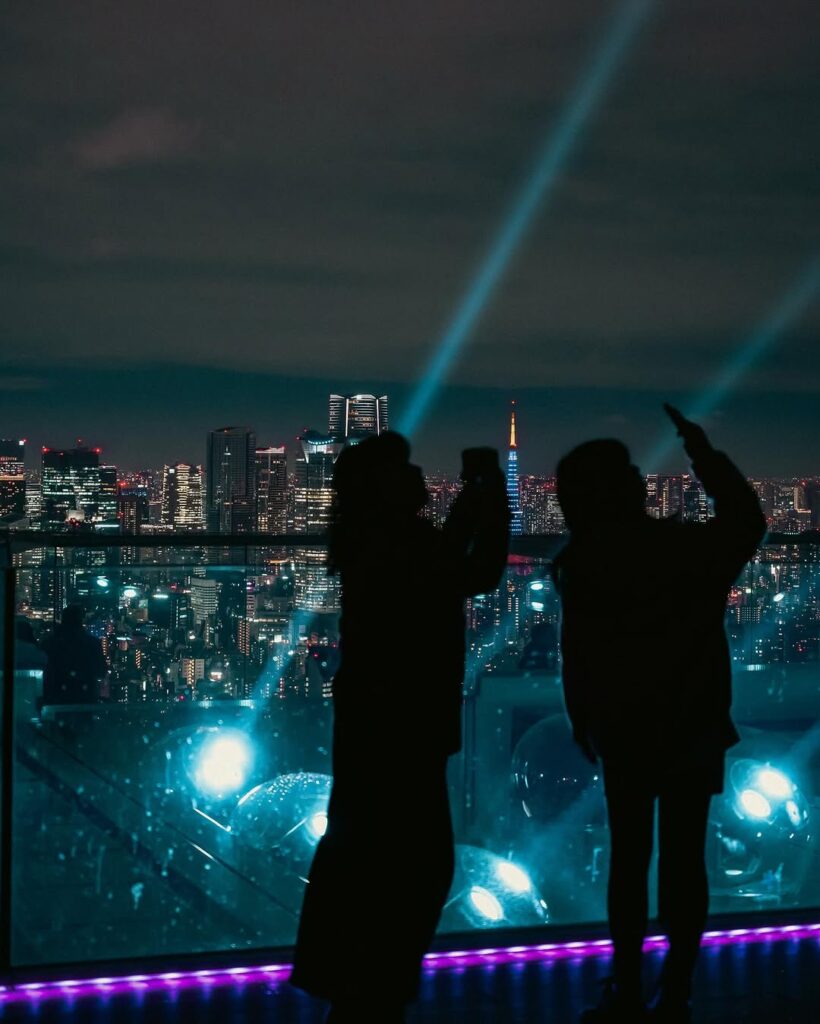
The vastness here isn’t intimidating — it’s liberating. People come up exhausted, weighed down, and descend a little lighter. Because from up here, problems shrink. The skyline stretches forever. And the world feels infinitely bigger than whatever you were worrying about ten minutes ago.
And if you need an excuse to linger, claim one of the rooftop nets, lie back, and just stare straight up into the blue. No phones. No rush. Just you and the sky — a rare pocket of stillness in a city that never stops.
Descent to Earth – And Some Retail Therapy
Eventually, though, gravity calls. When you’ve soaked in enough skyline for one day, it’s time to beam back down to reality. But not before a stop at the souvenir shop, of course — because what’s a proper Tokyo adventure without some Shibuya Sky merch? Expect Hachiko-themed goodies, skyline prints, and enough cute trinkets to fill a carry-on.

The elevator ride down is a mini event of its own — one moment you’re floating among clouds, the next you’re back on the 14th floor. And guess what? More shops await. My favorite? The Hachiko shop, dedicated entirely to Japan’s most beloved dog.

Still haven’t scratched that retail itch? Take the escalators down into the Shibuya Sky department store and keep browsing — you’re in one of Tokyo’s shopping heartlands, after all.

Practical Info – How to Do Shibuya Sky Right (and Without Stress)
Alright, logistics time — because nothing kills that floating-above-Tokyo vibe faster than getting lost, missing a time slot, or showing up in flip-flops on a windy day. Here’s how to make your visit as smooth as the skyline itself:
How to Get There:
Shibuya Sky is perched atop Shibuya Scramble Square, directly above Shibuya Station. Translation: if you’ve found the station, you’ve basically found the Sky Deck. Look for the East Wing elevators and follow the signs for “Shibuya Sky.” And if you’re still not sure? Ask. Tokyo staff are famously kind and more than happy to point you skyward.
By Train:
On JR lines like the Yamanote Line, Saikyo Line, or Shonan-Shinjuku Line, hop off directly at Shibuya. Subway options like the Ginza, Hanzomon, and Fukutoshin lines will also land you right underneath the building.
Tickets – Book Early or Regret It:
We booked our tickets in advance on Klook — and so should you. Sunset slots sell out faster than ramen in a lunch rush, and even weekday afternoons can vanish days ahead. Trust us, “winging it” is a bad plan here.
Prices (as of 2025):
- Adults (12+): ¥2,700–¥3,400 (time-slot dependent)
- Children (6–11): ¥1,200
- Under 6: Free
💡 Booking online isn’t just about convenience — it’s also cheaper than buying on-site.
Opening Hours:
Daily from 10:00 a.m. to 10:30 p.m. (last entry at 9:20 p.m.). Hours shift seasonally and for special events, so double-check the official website before heading out.
✨ Pro Tip: Book a slot roughly one hour before sunset — you’ll catch three moods in one visit: bright daylight, golden hour glow, and the first twinkle of neon night.
🚫 What’s Banned on the Deck:
Anything that can take flight. Bags, hats, and headphones stay in the free lockers. Food, drinks, and selfie sticks are also a no-go. Cameras and phones are fine, as long as they’re strapped to you.
Final Checklist:
- Bring a windbreaker — gusts get serious up there, especially in winter.
- Check the forecast — heavy rain or lightning can shut the deck temporarily.
- Charge your camera — you’ll take more photos than you think.
Shibuya Sky Tokyo: Is It Worth It?
Here’s the honest truth: yes — Shibuya Sky is absolutely worth it. And not just because it gives you one of the best panoramic views in Tokyo (though it does that in spades). It’s because the whole experience — from the spaceship-like elevator ride to the hush that falls over you 229 metres above the city — is pure magic. It’s not just about sightseeing; it’s about shifting your perspective. Down below, the city churns with life, but up here, you get to pause, breathe, and watch it all unfold like a living map.
Even if you’ve climbed other towers or seen Tokyo from other vantage points, nothing quite compares to the way Shibuya Sky blends thrill and tranquility. You’ll feel the wind in your hair, the sun on your face, and the hum of the city vibrating below you. And then there’s the moment — that almost spiritual instant — when Mount Fuji materialises on the horizon or Shibuya Crossing turns into a perfect, chaotic ballet beneath your feet. Those are the memories that stay with you long after you’ve taken the elevator back down.
So, is it worth the ticket price, the planning, the pre-booking? Without a doubt. Shibuya Sky isn’t just a view — it’s an experience. One that lets you feel small and infinite at the same time. And once you’ve seen Tokyo from up there, you’ll never look at the city the same way again.
Ready to See Tokyo From a New Perspective?
Shibuya Sky isn’t just an observation deck — it’s one of those rare places that changes the way you experience the city. Book your tickets ahead of time, time your visit for golden hour, and give yourself a few extra minutes to simply stand still and watch Tokyo move below you. It’s the kind of travel memory that lingers long after you’re back on the ground.
Planning your Tokyo adventure? Check out our full guides to things to do in Shibuya and where to eat in Tokyo for even more insider tips and inspiration.
- Nagoya rainy day with kids in 2026 (Cool Indoor Things to Do )
- Best Gachapon in Tokyo (2026): 20 Places to Find Capsule Toys

- All Japanese KitKat Flavours List: The Ultimate Japan KitKat Guide

- Sapporo rainy day with kids (2026): 7 Cool Indoor Things to Do
- What To Do In Arashiyama With Kids: A Realistic One-Day Family Itinerary