I spill travel tips , and show you the Japan that tourists usually miss.
Worried about navigating Tokyo? Discover how to get around Tokyo in a 3 easy ways—covering trains, IC cards, tourist passes, and simple tips to travel like a pro.
| ➡️Planning a trip to Tokyo ? Discover top things to do in Tokyo, local eats, cultural spots, seasonal events, and day trips in this complete Tokyo travel guide—perfect for first-time visitors and returning travelers alike. |
Table of Contents
More Japan travel planning guides
Now that your phone is loaded with the right apps, it’s time to sort the rest: routes, transport cards, rail passes, and the itinerary that stops your trip from turning into beautiful chaos.
- best Japan itinerary — the smartest routes, travel flow, and practical tips for planning your trip.
- Suica card in Japan — how to use Japan’s essential IC card for trains, subways, buses, and everyday payments.
- is the Japan Rail Pass worth it — a realistic 2026 guide to whether the JR Pass still saves you money.
- two weeks in Japan itinerary — a complete first-timer route covering Tokyo, Kyoto, Osaka, and beyond.
Way 3 – Walking
Is it a good idea to walk around Tokyo when we visit Tokyo? It depends on where we want to go.
For example, I marked 4 routes in Google Maps:
- Asakusa (specifically Kaminarimon “Thundergate”) – Tokyo Sky Tree.
The distance on foot is about 1.3 km, the time needed to walk is 17 minutes.
Route link: https://goo.gl/maps/92pDi4Qa7eBNFfQt8 - Asakusa (specifically Kaminarimon “Gate of Thunder”) – Akihabara .
The distance on foot is about 2.7 km , the time needed to walk is 36 minutes .
Route link: https://goo.gl/maps/ZvEH9n4veZuxqV2H9 - Ueno Station – Akihabara Station .
The distance on foot is about 1.4 km , the time needed to walk is 18 minutes .
Route link: https://goo.gl/maps/RKUvPXBZx2cbUnMz8 - Asakusa (specifically Kaminarimon “Gate of Thunder”) – Shibuya station .
The distance on foot is about 12 km, the time needed to walk is 2 hours and 36 minutes .
Route link: https://goo.gl/maps/JzfTjmeVuU3n7RndA
Examples 1, 2, and 3 provide the opportunity to explore the surrounding areas on foot and discover interesting places, shops, and restaurants. Walking allows us to discover the “ordinary” streets and alleys of Japan. When traveling from Asakusa to Tokyo Sky Tree, looking up is enough to stay on course and avoid getting lost.
Example number 4 involves a longer route, approximately 12 km long, from the “Thunder Gate” in Asakusa to Shibuya station, where we can find famous landmarks like the Hachiko statue and Shibuya Crossing. While it is possible to walk this route, it would take over 2.5 hours.
- Alternatively, we can take the subway, which will get us there in about 30 minutes. However, if the distance between our destinations is not too far, walking can be a great way to explore Tokyo‘s streets and avoid the crowded subway during peak hours and nice weather.
Way 2 – Yamanote Line
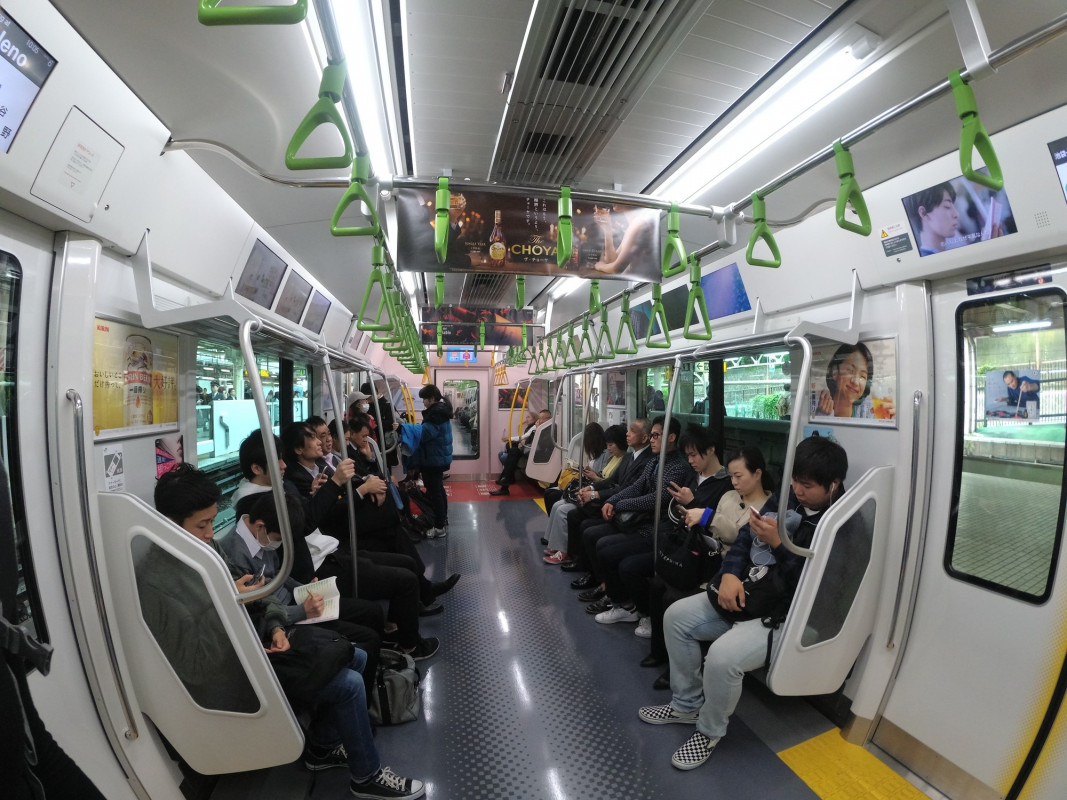
One of the most important railway lines in the Japanese capital is the Yamanote circular line connecting the most important districts in Tokyo. Trains run every 2-4 minutes in each direction and the journey takes about 60 minutes. The most important stations are Tokyo Station, Shinjuku, Shibuya, Shinagawa, Ikebukuro, Ueno, Akihabara.
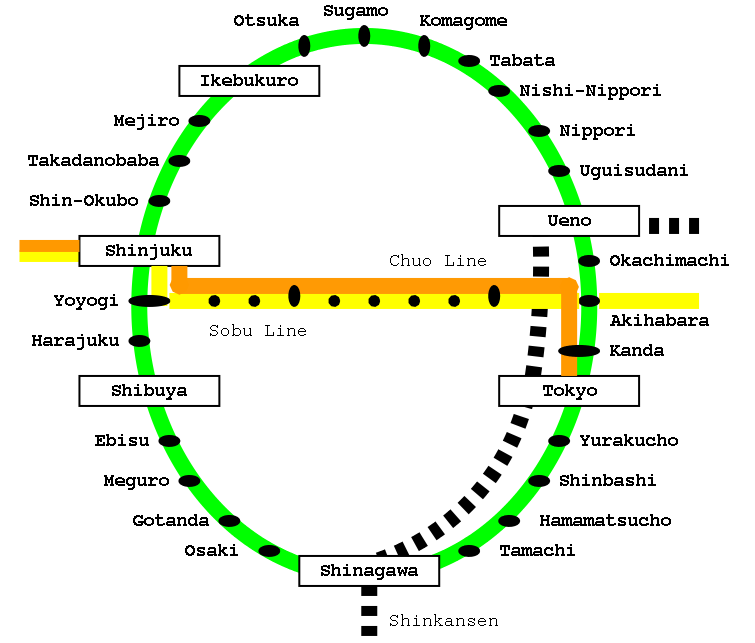
If you have a JR PASS ticket, you can travel on this line for free. In some cases, such as between Tokyo and Shinjuku Station, the fastest transport option will not be the Yamanote line or the subway – the JR Chuo line will be. It is always worth checking carefully which railway line will get you to your destination the fastest. An interesting fact is that each station of the Yamanote line has an individual theme tune played when the train arrives at the station.
Way 1 – Subway
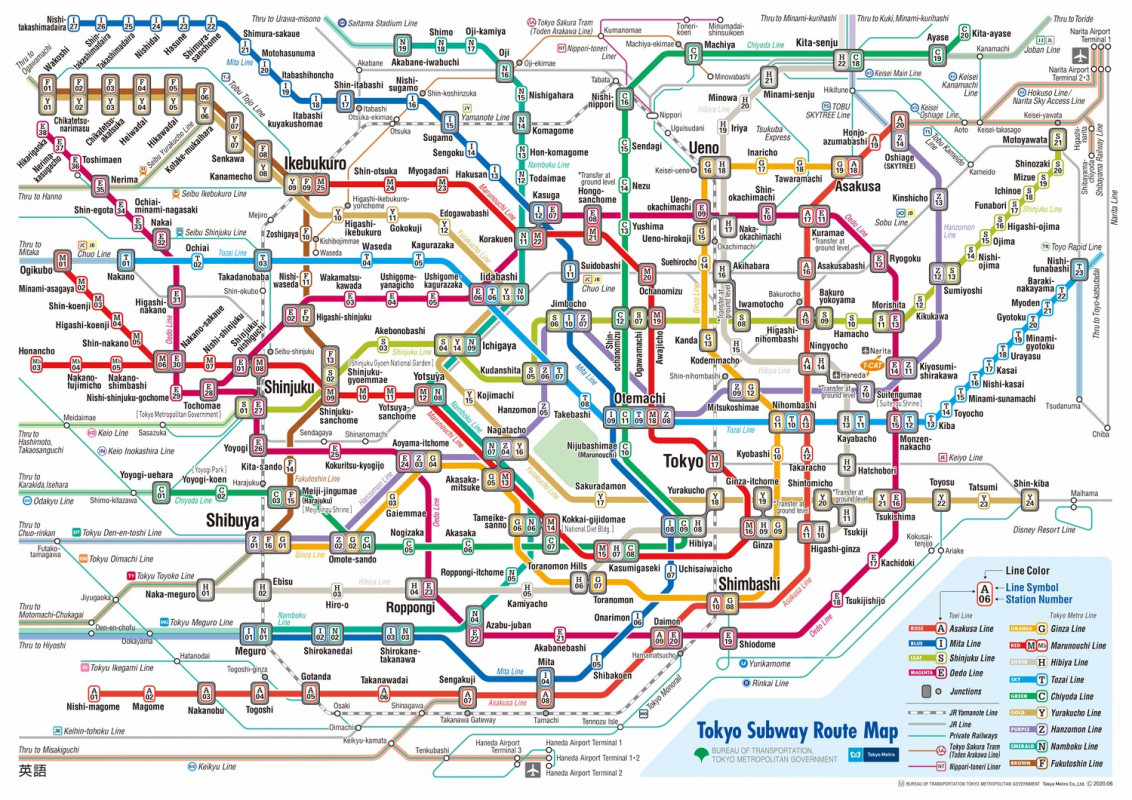
The vast Tokyo subway system is composed of 13 lines and almost 300 stations, with a total length of over 300 km, managed by two companies: Tokyo Metro and Toei Subway. Surprisingly, there is no station where all the lines meet. A map of the subway lines may appear daunting at first, but the system is easy to navigate and intuitive, making it unlikely to cause any issues for travelers.
How to “read” a subway map?
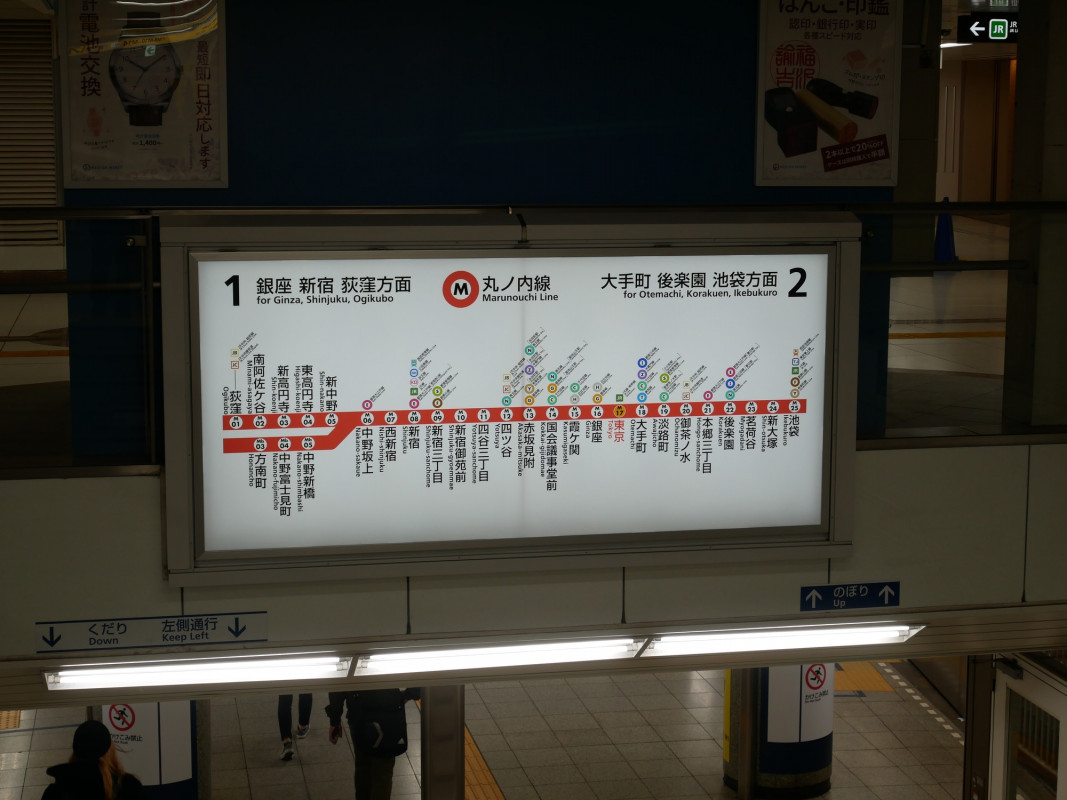
Let’s use an example to better understand how to navigate the Tokyo subway system, specifically for a ride between Tokyo and Shibuya station:
On the subway map, Tokyo station is marked with the symbol M17, and Shibuya station with the symbols Z01, F16, and G01. The red border around the M17 station symbol represents the color of the metro line, which in this case is the Marunouchi Line. The letter “M” represents the symbol of this line, followed by the station number, which is 17 in this case.
Since Tokyo and Shibuya stations are not directly connected by Line 1, a transfer is necessary.
We need to find a station on the subway map where the subway lines from the starting station intersect with the subway lines that go to the destination station. In this case, the red subway line from Tokyo station intersects with the subway lines from Shibuya station at several points.
To get to Shibuya station, we can take the Marunouchi Line from the M17 station to the Ginza station (M16) and then transfer to the orange Ginza Line from the G09 station (where the red, silver, and orange metro lines connect) directly to the G01 station at Shibuya.
Although it may be necessary to make 2 or 3 transfers in other situations, using the subway is simple and intuitive with the help of the map.
- Alternative connections are M16 → M18 / Z08 → Z01 or M16 → M09 / F13 → F16 . After a few rides, no one would have any problems with traveling by subway if only we knew the starting and ending stations. Even if we make a mistake and go in the opposite direction, we can get off at the nearest station and turn around.
Tokyo subway – prices
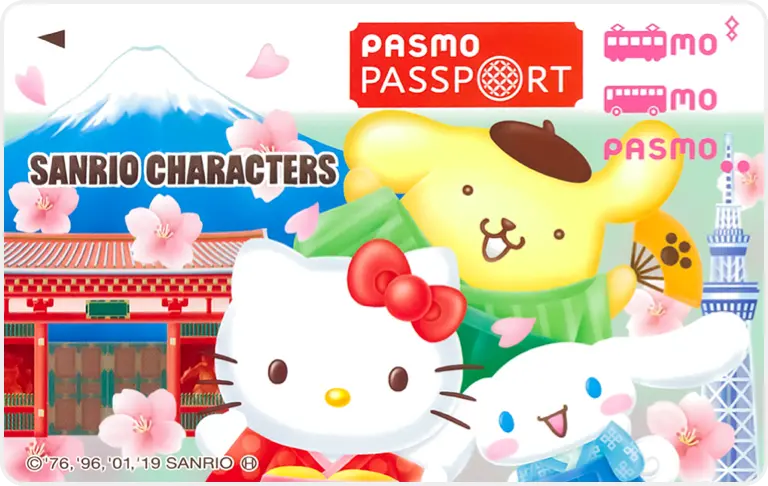
Prepaid cards, such as Suica or PASMO, are another option for traveling around Tokyo. These can be purchased at ticket vending machines located at almost every metro station and marked with the Suica or PASMO logo. A special version of the PASMO card called “PASMO PASSPORT” is available exclusively for tourists. It is valid for 28 days, differs in appearance from the standard card, and can only be purchased at specific locations listed on the website. The cost of the card is 2000 yen, of which 1500 yen can be used, and the card can be topped up if necessary.
IC cards, such as Suica and PASMO, can be used to pay for subways, trains, buses, vending machines, and some shops and restaurants. To use the card when traveling by subway, select the appropriate gate marked with the “IC Card” inscription, and apply the card to the “reader” of the gate where tickets are validated. The appropriate amount will be charged to the card when passing through the gate to leave the subway platform.
For those planning to travel frequently by subway, purchasing tickets valid for a certain period is the most cost-effective option. These tickets are available for 24 hours (price 800 yen), 48 hours (price 1200 yen), and 72 hours (price 1500 yen). It is convenient to purchase these tickets upon arrival at the airport or tourist information points located in several places in Tokyo. To pass through the subway gates, insert the ticket on one side, pass through the gate, and collect the ticket on the other side, making sure not to leave the ticket behind.
Yurikamone Line

A Yurikamone line is somewhat complementary to the metro line. Thanks to the fully automatic trains (there is no driver in them), we will get to the island of Odaiba . However, we must remember that travel on this line is not possible with 24-hour tickets, multi-day tickets, or with the JR PASS ticket. To get to the artificial island of Odaiba, where there are, among others, attractions such as a huge Gundam robot or a replica of the Statue of Liberty, it is most convenient to use a prepaid card, e.g. PASMO.
The basis is a good sightseeing plan

Although the subway runs every few minutes and it will take you to the most important tourist places in Tokyo, the basis is a good sightseeing plan so as not to waste our time. If we only have a few days for Tokyo, we can mark all the places we want to see on the map and then group them by distance and the days on which we will visit them. For example, on one day attractions in the vicinity of Asakusa, Ueno, Akihabara on another day Shibuya, Harajuku on the next Shinjuku, Ikebukuro on the next central Tokyo and Ginza, etc.
Of course, this is just an example and it all depends on how many days we have for visiting Tokyo and what exactly we want see.
I hope all the tips in my article will help you move smoothly and quickly around Tokyo!
FAQs: How to Get Around Tokyo
What’s the easiest way to pay for trains and buses?
Use a reloadable IC card like Suica or PASMO (physical or on your phone). Tap in, tap out, done.
Can I add Suica/PASMO to my phone?
Yes. Most iPhone and many Android devices support Mobile Suica/PASMO in Wallet/Pay apps. It’s the smoothest option and easy to top up.
Do I need the Japan Rail Pass just for Tokyo?
Usually no. The JR Pass shines on long intercity trips. Inside Tokyo, pay-as-you-go with an IC card is simpler and often cheaper.
JR vs Metro—what’s the difference?
JR lines (like the Yamanote Loop) are run by Japan Railways; subways are run by Tokyo Metro & Toei. Your IC card works on all, but day passes often cover only subways—check the fine print.
Are there good day passes for tourists?
Yes: the Tokyo Subway Ticket (24/48/72-hour) covers Tokyo Metro + Toei. Great if you’ll ride a lot in a short window.
How bad is rush hour, really?
Packed. Avoid roughly 7:30–9:30 and 17:30–19:30 if you can. If you must go, stand clear of doors, remove backpacks, and move inside quickly.
When do trains run?
Frequent from early morning until around midnight (varies by line). Always check the time of your last train—taxis get pricey after.
Are buses worth using?
Yes for short hops or areas with fewer trains. Tap your IC card when you board (and sometimes when you exit—watch the signs).
How do I get from the airports to the city?
Haneda: Tokyo Monorail (to JR lines) or Keikyu (to Asakusa/Ginza routes).
Narita: JR Narita Express or Keisei Skyliner to central hubs. IC cards and reserved seats both work.
Is walking a good idea in Tokyo?
Absolutely. Neighborhoods like Shinjuku, Shibuya, Asakusa, and Ginza are very walkable—use trains between areas and your feet within them.
Can I bike around?
Yes—look for bike share docks and dedicated lanes in some districts. Stick to bike rules and be mindful of pedestrians.
What about taxis and ride-hailing?
Taxis are plentiful and clean; card and mobile payments are common. Uber and local apps (e.g., GO) often dispatch regular taxis. Expect higher costs versus trains.
Any etiquette tips on transit?
Queue lines, no loud calls, priority seats for those who need them, bags off your back, and stand on the correct side of escalators (watch what locals do—varies by station).
Can I send my luggage ahead?
Yes—takkyubin (luggage forwarding) will ship bags hotel-to-hotel or airport-to-hotel. Travel light on trains; it’s bliss.
How do I plan routes without stress?
Use apps like Google Maps, Japan Travel (Navitime), or Yahoo! Transit. Toggle filters for “fewest transfers” or “least walking” if you’re tired.
LATEST POSTS:
- Nagoya rainy day with kids in 2026 (Cool Indoor Things to Do )

- Best Gachapon in Tokyo (2026): 20 Places to Find Capsule Toys

- All Japanese KitKat Flavours List: The Ultimate Japan KitKat Guide

- Sapporo rainy day with kids (2026): 7 Cool Indoor Things to Do
- What To Do In Arashiyama With Kids: A Realistic One-Day Family Itinerary